Overview
The performance of an HPLC column depends not only on the stationary phase but also on the quality of the fluidic connections. Improper tubing connections, incorrect seating depth, and excessive dead volume can significantly reduce chromatographic efficiency and compromise method performance.
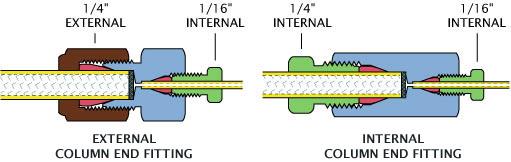
Cogent TYPE-C™ analytical columns are designed with industry-standard end-fitting geometry to provide compatibility with modern HPLC systems while maintaining low-dispersion fluidic pathways.
Analytical Column End-Fitting Specifications
Cogent TYPE-C™ analytical columns utilize:
- Valco® standard sealing depth
- Type 316 stainless steel end fittings
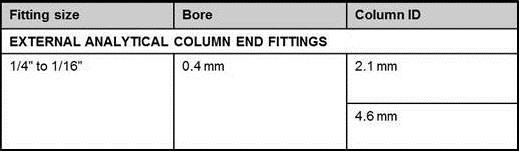
- 0.4 mm end-fitting bore
These dimensions provide reliable sealing, broad instrument compatibility, and a balance between low dead volume and mechanical durability.
Sealing Depth
The Valco® standard seating depth is widely recognized throughout the chromatography industry and helps ensure reproducible tubing alignment and sealing performance across different instrument platforms.
End-Fitting Bore
Analytical columns utilize a 0.4 mm bore end fitting designed to:
- Minimize dead volume
- Reduce peak dispersion
- Support efficient chromatographic performance
- Maintain pressure stability
End-Fitting Material
Type 316 stainless steel offers:
- Excellent corrosion resistance
- High-pressure compatibility
- Long service life
- Reliable mechanical strength
For additional information about stainless steel grades used in chromatography hardware, view 316L Stainless Steel Specifications and HPLC Hardware Materials Information.
Recommended Connection Hardware
Direct Adaptive Di-Ad™ Column Connectors
Unlike traditional ferrule-based fittings, Di-Ad™ connectors are not permanently swaged to a fixed tubing position. This design helps maintain proper tubing engagement and minimizes connection-related dead volume.
Benefits include:
- Consistent low-dead-volume connections
- Elimination of permanent ferrule swaging
- Easier tubing reuse
- Reduced installation errors
- Improved chromatographic reproducibility
Why Connection Quality Matters
Critical system interfaces include:
- Injector to column
- Guard column to analytical column
- Column to detector
Even small connection gaps may create mixing chambers that contribute to:
- Peak broadening
- Resolution loss
- Reduced efficiency
- Poor peak shape
- Variable retention times
Maintaining proper tubing engagement at these locations is essential for high-performance chromatography.
Common Seating Depth Problems
Tubing Inserted Too Deep
When tubing is pushed too far into the receiving port:
- Sealing may be compromised
- Tubing ends may become damaged
- Fitting performance may suffer
Tubing Inserted Too Shallow
When tubing does not fully reach the column seat:
- Dead volume may be created
- Band broadening may occur
- Early-eluting peaks may become distorted
- Overall efficiency may decrease
Proper seating depth is one of the most important factors in achieving optimum chromatographic performance.
Installation Best Practices
Use Properly Prepared Tubing
Before installation:
- Produce a clean, square tubing cut
- Remove burrs from the tubing end
- Inspect for damage or deformation
Avoid Excessive Tightening
Overtightening fittings may result in:
- Damaged ferrules
- Distorted tubing
- Connection failure
- Difficulty during future maintenance
Verify Connections After Pressurization
After installation:
- Inspect for leaks
- Confirm stable system pressure
- Verify normal chromatographic performance
Guard Column Considerations
To maintain system performance:
- Match guard column chemistry to the analytical column.
- Use the proper guard holder.
- Match column and guard dimensions where appropriate.
- Minimize additional dead volume at connection points.
Proper guard column installation helps protect analytical columns without negatively affecting chromatographic selectivity.
Low-Dispersion Connection Checklist
Before operating the system:
- Verify Valco® standard end-fitting geometry.
- Confirm the 0.4 mm analytical column bore specification.
- Use properly prepared tubing.
- Verify correct seating depth.
- Inspect for leaks after pressurization.
- Use low-dead-volume connection hardware when possible.
- Confirm guard column compatibility when installed.
Key Takeaways
- Cogent TYPE-C™ columns use Valco® standard sealing depths.
- Analytical columns feature a 0.4 mm bore and Type 316 stainless steel end fittings.
- Proper seating depth is essential for maintaining chromatographic efficiency.
- Connection gaps can create dead volume and peak broadening.
- Di-Ad™ connectors help reduce installation errors and dead-volume formation.
- Careful tubing preparation and proper installation techniques support optimum HPLC performance.